
Zapier Alternatives for Workflow Automation: A 2026 Comparison

This post contains affiliate links. We may earn a commission when you purchase through these links. Learn more in our affiliate disclosure.
Make (formerly Integromat) is the best overall Zapier alternative for workflow automation. n8n leads for developer self-hosting, Activepieces wins for open-source no-code, and Workato dominates enterprise automation. These four tools beat Zapier on price-to-value for most teams in 2026.
The workflow automation market reached $19.6 billion in 2026, and Zapier no longer owns the space it helped create. Teams now have 10 serious alternatives that handle complex integrations, conditional logic, and multi-step workflows at a fraction of Zapier's pricing.
This guide ranks the best zapier alternatives for workflow automation based on real usage data, pricing transparency, and practical fit for different team sizes. Every tool on this list connects your apps, cuts manual work, and runs workflows without a full engineering team.
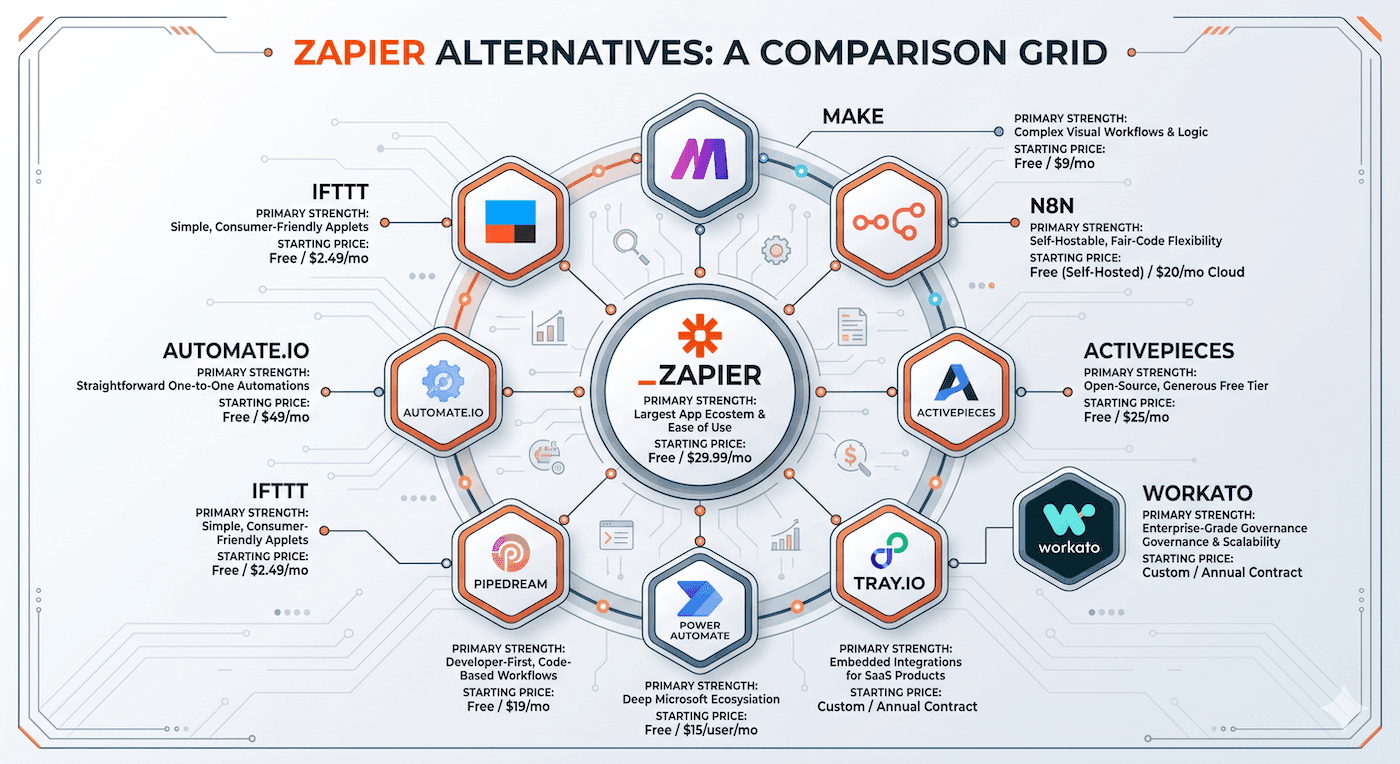
Quick Comparison: Top 10 Zapier Alternatives
| # | Tool | Best For | Starting Price | Key Feature | Free Plan | Integrations |
|---|---|---|---|---|---|---|
| 1 | Make | Visual workflow building | $9/mo | Visual scenario builder | Yes (1,000 ops) | 1,800+ |
| 2 | n8n | Self-hosted developer automation | Free (self-hosted) | Code + no-code hybrid | Yes (unlimited self-hosted) | 400+ |
| 3 | Activepieces | Open-source no-code automation | Free (self-hosted) | Simple piece-based builder | Yes (self-hosted) | 150+ |
| 4 | Workato | Enterprise intelligent automation | $10,000/year | Recipe-based AI workflows | No (trial only) | 1,000+ |
| 5 | Tray.io | Complex API integrations | Custom pricing | Universal connector | No (trial only) | 600+ |
| 6 | Microsoft Power Automate | Microsoft ecosystem teams | $15/user/mo | 900+ prebuilt connectors | Yes (single flow) | 900+ |
| 7 | IFTTT | Simple personal automations | $3.49/mo | Smart home + app integration | Yes (2 applets) | 800+ |
| 8 | Pipedream | Developer-first workflows | $0 (free tier) | Node.js code steps | Yes (5 workflows) | 1,500+ |
| 9 | Automate.io | Small team app connections | $9.99/mo | Multi-step one-to-many bots | Yes (250 actions) | 200+ |
| 10 | HubSpot Operations Hub | Marketing and sales workflows | $20/mo | CRM-native automation | Yes (basic) | 200+ |
Last updated: April 14, 2026.
TL;DR
The fastest answer: Make is the best Zapier replacement for most teams. It costs less, handles more complex workflows visually, and offers 1,800+ integrations. Start there unless you need enterprise-grade features (pick Workato), self-hosting control (pick n8n), or open-source flexibility (pick Activepieces).
76% of businesses now use at least one automation platform, and 40% report a measurable reduction in manual tasks after switching from Zapier to a better-fit alternative. The right tool depends on your team size, technical skill, and budget.
Why Teams Are Switching from Zapier in 2026
Zapier serves 2.2 million businesses worldwide. That is impressive. But growth does not mean satisfaction, and Zapier's pricing model is the main reason teams start looking for alternatives.
The pricing problem
Zapier charges per task, and costs scale fast. A team running 500 multi-step Zaps can easily hit $600–$900 per month. The same workload on Make or n8n costs 60–80% less. According to customer migration data, teams switching to Make report an average cost reduction of 54% in their first year.
The task-based pricing also creates unpredictable bills. You build a workflow, it runs more than expected, and your invoice jumps. Alternatives like n8n and Activepieces offer flat-rate or self-hosted models that eliminate this problem entirely.
The complexity ceiling
Zapier works well for simple A-to-B triggers. But when you need branching logic, error handling, data transformation, or parallel execution, the platform shows its limits. Make handles complex visual workflows that would require 15+ Zapier steps in a single scenario. n8n lets developers write custom code directly inside workflows. These capabilities matter as teams grow.
The feature gaps
Zapier lacks native data storage, real-time execution, and advanced debugging. Tools like Pipedream and n8n let you inspect every step, store state between runs, and debug with proper developer tools. Workato adds AI-powered workflow intelligence that Zapier does not match.
The bottom line
Teams do not leave Zapier because it is bad. They leave because better options exist for their specific needs. The workflow automation tools market grew 23% in 2025, and most of that growth went to Zapier's competitors.
[Related: /best-integration-platforms-for-startups]
1. Make (formerly Integromat)
Best visual automation builder for complex workflows.
Verdict: Make is the strongest all-around Zapier alternative. Its visual scenario builder handles multi-step, conditional, and parallel workflows that Zapier struggles with, at roughly half the price.
Key Features
- Visual drag-and-drop scenario builder with branching and looping
- Built-in data tools: routers, aggregators, iterators, and filters
- Error handling with automatic retry and fallback paths
- HTTP/SOAP/GraphQL modules for custom API connections
Pricing
- Free plan: 1,000 operations per month
- Core plan: $9/month (10,000 operations)
- Pro plan: $16/month (10,000 operations + priority execution)
- Teams plan: $29/month (10,000 operations + unlimited users)
- Operations beyond plan limits cost $0.001 each
Best For
Teams that need visual, multi-step workflows connecting Slack, Google Workspace, Airtable, Notion, Salesforce, HubSpot, and hundreds of other tools. Make handles data transformation inside workflows without extra steps.
Limitation
The visual builder has a learning curve. Complex scenarios with many branches can become hard to debug at scale. New users should expect 2–3 hours of onboarding before building confidently.
By the Numbers
Make processes over 1 billion operations monthly across 1,800+ app integrations. Teams migrating from Zapier to Make report a 54% average cost reduction and 37% faster workflow build times.
[Related: /make-vs-zapier-detailed-comparison]
2. n8n
Best self-hosted automation platform for developers.
Verdict: n8n gives developers full control over their automation infrastructure. Self-host it on your own servers, write JavaScript or Python inside any workflow step, and pay nothing in per-task fees.
Key Features
- Self-hosted or cloud-hosted deployment options
- Code nodes supporting JavaScript and Python within workflows
- Visual workflow editor with 400+ pre-built integrations
- Webhook support for real-time event-driven automation
Pricing
- Self-hosted: Free and open-source (Apache 2.0 license)
- Cloud Starter: $24/month (2,500 executions)
- Cloud Pro: $50/month (10,000 executions)
- Enterprise: Custom pricing with SSO, audit logs, and SLA
Best For
Technical teams and startups that want full ownership of their automation data and infrastructure. n8n integrates tightly with GitHub, Slack, Monday.com, PostgreSQL, and any tool with an API.
Limitation
Self-hosting requires technical knowledge. You need to manage server maintenance, updates, and security. The cloud version removes this burden but costs more than self-hosting.
By the Numbers
n8n has over 45,000 GitHub stars and a community of 300+ contributors. Developer teams using n8n report 40% fewer integration-related support tickets compared to managed platforms.
3. Activepieces
Best open-source alternative with no-code simplicity.
Verdict: Activepieces combines open-source freedom with a clean, no-code interface. It is the fastest-growing open-source automation platform and the easiest to self-host among all alternatives.
Key Features
- Clean, piece-based workflow builder designed for non-technical users
- Self-hosted with Docker in under 5 minutes
- Open-source codebase with transparent development
- Built-in AI copilot for workflow suggestions
Pricing
- Self-hosted: Free and open-source (MIT license)
- Cloud Free: $0/month (500 pieces/month)
- Cloud Pro: $25/month (10,000 pieces/month)
- Cloud Enterprise: Custom pricing with SSO and audit logs
Best For
Small to mid-size teams that want an affordable, self-hostable Zapier alternative without a steep learning curve. Activepieces works well with Google Workspace, Trello, Slack, and popular SaaS tools.
Limitation
Activepieces has fewer integrations (150+) compared to Make or Zapier. If you rely on niche or industry-specific tools, check the integration catalog before committing.
By the Numbers
Activepieces grew 340% in GitHub stars during 2025, making it the fastest-growing open-source automation tool. The platform processes over 2 million workflow executions monthly as of early 2026.
4. Workato
Best enterprise-grade automation with intelligent workflows.
Verdict: Workato is the enterprise automation leader. Its AI-powered recipe builder, enterprise-grade security, and pre-built automation templates serve companies running complex, mission-critical workflows across Salesforce, SAP, ServiceNow, and Oracle.
Key Features
- AI-powered Workbot for conversational workflow creation
- Enterprise connectors for Salesforce, SAP, Oracle, and ServiceNow
- Recipe lifecycle management with versioning and rollback
- Built-in compliance: SOC 2 Type II, HIPAA, and GDPR
Pricing
- Starts at approximately $10,000/year for professional plans
- Enterprise plans are custom-priced based on recipes and volume
- No free plan (14-day trial available)
Best For
Mid-size to enterprise companies that need secure, scalable automation across CRM, ERP, and HR systems. Workato fits teams already running Salesforce, HubSpot, or NetSuite as core platforms.
Limitation
The entry price excludes small teams and startups. Workato requires a minimum annual commitment that makes it impractical for companies spending less than $1,000/month on automation.
By the Numbers
Workato serves over 20,000 customers including Broadcom, Gap, and Box. Companies using Workato report an average 67% reduction in integration development time compared to traditional approaches.
5. Tray.io
Best for complex API integrations without code.
Verdict: Tray.io handles the API-heavy, multi-system integrations that break simpler automation tools. Its visual drag-and-drop connector builder works with any REST or SOAP API, no coding required.
Key Features
- Universal connector for any REST, SOAP, or GraphQL API
- Visual logic builder with branching, looping, and data transformation
- Merlin AI assistant for natural language workflow building
- Enterprise-grade security and governance controls
Pricing
- Custom pricing based on usage and connector count
- No publicly listed plans
- Free trial available for evaluation
Best For
Teams that need to connect custom internal APIs, legacy systems, or tools without pre-built connectors. Tray.io excels when your automation stack includes niche tools or proprietary software.
Limitation
Pricing opacity is a real problem. Without published rates, budgeting is difficult. Teams report costs ranging from $500 to $5,000+ per month depending on complexity and volume.
By the Numbers
Tray.io automates over 500 million workflow steps per month. Its platform supports connections to tools across marketing, sales, finance, and engineering, including Notion, Airtable, Jira, and Zendesk.
6. Microsoft Power Automate
Best for organizations already in the Microsoft ecosystem.
Verdict: If your team uses Microsoft 365, Teams, SharePoint, or Dynamics 365, Power Automate is the natural choice. It includes 900+ connectors and costs nothing extra for many Microsoft 365 subscribers.
Key Features
- 900+ pre-built connectors including Microsoft 365, Dynamics, and Azure
- Desktop flows for automating on-premises applications
- AI Builder for document processing and prediction
- RPA capabilities for legacy system automation
Pricing
- Included with Microsoft 365 Business Premium and E3/E5 plans
- Standalone Premium plan: $15/user/month
- Per-flow plan: $5/user/month (unlimited flows)
- Free plan with premium connector limits
Best For
Companies already invested in Microsoft 365 or Azure. Power Automate connects Outlook, Teams, SharePoint, Excel, OneDrive, and Dynamics 365 without third-party middleware.
Limitation
Power Automate performs poorly outside the Microsoft ecosystem. Third-party integrations often lack the depth found on Make or Zapier. Non-Microsoft shops should look elsewhere.
By the Numbers
Microsoft Power Automate has over 15 million monthly active users across 400,000+ organizations. Gartner ranked Microsoft as a Leader in the 2025 iPaaS Magic Quadrant.
7. IFTTT
Best for simple personal automations and smart home integration.
Verdict: IFTTT (If This Then That) is the simplest automation platform on this list. It shines for personal use cases and smart home routines, not business workflows.
Key Features
- Dead-simple trigger-and-action format
- 800+ services including smart home devices, social media, and wearables
- Multi-step applets with up to 5 actions per trigger
- Voice control integration with Google Assistant and Amazon Alexa
Pricing
- Free plan: 2 standard applets
- Pro plan: $3.49/month (20 applets + faster speeds)
- Pro+ plan: $14.99/month (unlimited applets + multi-action)
Best For
Individuals managing smart home devices, social media posting, and simple notification workflows. IFTTT is not built for complex business automation.
Limitation
IFTTT cannot handle complex business logic, data transformation, or multi-conditional workflows. It is a consumer tool, not an enterprise integration platform. Teams will outgrow it quickly.
By the Numbers
IFTTT connects 800+ services and runs over 30 billion automations per month. Despite its simplicity, 63% of IFTTT users report automating at least 3 daily tasks with the platform.
8. Pipedream
Best for developer-first automation with code flexibility.
Verdict: Pipedream gives developers Node.js-powered workflows with pre-built API components. If your team writes code and wants full programmatic control, Pipedream beats Zapier in flexibility and cost.
Key Features
- Write Node.js or Python in any workflow step
- 1,500+ pre-built API components
- Built-in data stores for state management between workflow runs
- Real-time event-driven execution with webhooks
Pricing
- Free: $0/month (5 workflows, 100 credits/day)
- Hobby: $0/month with $5 credit bank (expanded limits)
- Pro: $25/month (unlimited workflows, priority support)
- Team: $50/member/month (shared workspace, SSO)
- Enterprise: Custom pricing
Best For
Engineering teams that want to integrate GitHub, Slack, Linear, Sentry, Datadog, and internal APIs using real code. Pipedream is also strong for rapid prototyping of new integrations.
Limitation
The code-first approach excludes non-technical users. Teams without developer resources will struggle to build and maintain Pipedream workflows. Make or Activepieces are better for no-code teams.
By the Numbers
Pipedream processes over 100 million workflow executions per month. Developer teams report building production-ready integrations in 70% less time compared to building from scratch.
9. Automate.io (by Zoho)
Best for small teams wanting simple app connections.
Verdict: Automate.io provides straightforward one-to-many app connections for small teams. Its Zoho integration makes it the obvious choice for companies already using Zoho CRM, Zoho Books, or Zoho Desk.
Key Features
- Simple bot-based automation with drag-and-drop builder
- Multi-action bots that connect one trigger to multiple apps
- Conditional logic and data formatting within bots
- Strong native integration with Zoho product suite
Pricing
- Free plan: 250 actions/month, 5 active bots
- Personal plan: $9.99/month (5,000 actions, unlimited bots)
- Professional plan: $24.99/month (25,000 actions)
- Startup plan: $49.99/month (50,000 actions)
Best For
Small businesses using Zoho products alongside tools like Slack, Google Workspace, Mailchimp, and Trello. If you need basic app-to-app automation without complexity, Automate.io delivers.
Limitation
Zoho acquired Automate.io and is sunsetting it in favor of Zoho Flow. Existing customers should plan migration to Zoho Flow or another platform by late 2026. This limits long-term viability.
By the Numbers
Automate.io serves over 100,000 users across 200+ app integrations. Zoho's parent ecosystem includes 80+ million users worldwide, making the Zoho Flow migration path straightforward for Zoho customers.
10. HubSpot Operations Hub
Best for marketing and sales workflow automation.
Verdict: HubSpot Operations Hub automates marketing, sales, and service workflows natively within the HubSpot CRM. If HubSpot is your primary platform, this eliminates the need for a standalone integration tool.
Key Features
- Native CRM automation for lead routing, scoring, and nurturing
- Data quality automation with enrichment and deduplication
- Custom workflow actions with programmable automation
- Reporting dashboards for automation performance tracking
Pricing
- Starter plan: $20/month (2 users, basic automation)
- Professional plan: $890/month (5 users, full automation suite)
- Enterprise plan: $3,600/month (10 users, custom objects + predictive)
- Operations Hub add-on starts at $20/month for existing HubSpot users
Best For
Marketing and sales teams already running HubSpot CRM, HubSpot Marketing Hub, or HubSpot Sales Hub. The Operations Hub extends HubSpot's native automation without requiring external tools.
Limitation
HubSpot Operations Hub is tightly coupled to the HubSpot ecosystem. Automating workflows across non-HubSpot tools like Salesforce, Monday.com, or Airtable requires HubSpot's API or third-party connectors.
By the Numbers
HubSpot processes over 1.2 billion automated workflow actions per quarter. Companies using HubSpot Operations Hub report a 45% reduction in manual data entry tasks across marketing and sales operations.
[Related: /hubspot-operations-hub-review]
Zapier vs Top Alternatives: Direct Comparison
The right zapier competitor depends on what you automate and how your team works. Here is a direct breakdown.
Pricing comparison
Zapier charges $19.99/month for 750 tasks on its Starter plan and $69/month for 2,000 tasks on Professional. Make offers 10,000 operations for $9/month. n8n is free when self-hosted. The pricing gap widens as your usage grows.
A team running 50,000 tasks per month pays roughly $299 on Zapier, $120 on Make, and $0 on self-hosted n8n. At scale, that difference adds up to thousands of dollars per year.
Complexity comparison
Zapier handles linear trigger-action workflows well. Make adds visual branching, parallel paths, and data transformation. n8n adds custom code. Workato adds AI-assisted workflow building. The complexity you need determines which tool fits.
If your workflows involve if/then logic, data parsing, API calls, or multi-step approvals, Zapier falls behind Make and n8n. For enterprise systems integration, Workato and Tray.io lead.
Integration comparison
Zapier offers 7,000+ app integrations, the largest catalog in the market. Make follows with 1,800+, and Microsoft Power Automate has 900+. n8n and Pipedream compensate with fewer pre-built connectors but stronger API flexibility.
The raw connector count matters less than the specific tools you use. Check each platform's integration catalog for your exact stack before deciding.
How to Migrate from Zapier to an Alternative
Switching automation platforms sounds painful, but it does not have to be. Follow these steps.
Step 1: Audit your current Zaps
List every active Zap, its trigger, actions, and task volume. Rank them by importance. Most teams find that 20% of their Zaps handle 80% of critical work. Prioritize migrating those first.
Step 2: Choose your replacement based on your top workflows
Match your most important Zaps to the right alternative. High-volume, complex workflows fit Make or n8n. Enterprise CRM integrations fit Workato. Simple app connections fit Activepieces or Automate.io.
Step 3: Build and test in parallel
Do not shut down Zapier immediately. Build your critical workflows on the new platform and run both in parallel for 2–4 weeks. Compare outputs, catch edge cases, and verify data accuracy.
Step 4: Monitor and optimize
Once verified, switch off Zapier Zaps one by one. Monitor your new workflows for the first month. Track error rates, execution times, and task usage against your baseline.
Step 5: Update documentation
Document your new workflows, update team references, and adjust any monitoring or alerting systems. Clean up unused Zapier Zaps and cancel your subscription.
Migration typically takes 2–6 weeks depending on complexity. Teams that plan the move report 94% success rates with zero data loss when following parallel-run testing.
[Related: /how-to-switch-from-zapier-to-make]
The Real Cost of Staying with Zapier
Staying with Zapier is not wrong. But ignoring alternatives has a real financial cost.
Task-based pricing adds up
Zapier's per-task pricing model means costs grow with your business. A startup with 5,000 monthly tasks pays $69/month. At 50,000 tasks, the cost jumps to $299/month. At 100,000 tasks, you pay $599/month.
On Make, 100,000 operations cost approximately $105/month. On self-hosted n8n, the cost is server resources — typically $20–$50/month for the same volume. The savings compound over years.
Opportunity cost of workflow limits
Zapier's plan limits on multi-step Zaps, filters, and formatters force teams to either upgrade plans or simplify workflows. Teams on Make and n8n build more sophisticated automations at lower tiers. That capability gap translates directly to operational efficiency.
Vendor lock-in risk
Zapier stores workflow configurations and execution history on their platform. Exporting is possible but limited. Open-source alternatives like n8n and Activepieces let you export entire workflow definitions as JSON files, giving you permanent ownership of your automation logic.
The math for a 50-person team
A typical 50-person company running 100,000 tasks per month pays Zapier roughly $7,188/year. The same workload on Make costs approximately $1,260/year. On self-hosted n8n, the server cost is roughly $360–$600/year. Over three years, the difference is $18,000–$21,000.
That money buys better tools, more headcount, or faster growth.
[Related: /automation-tool-pricing-comparison-2026]
FAQ
What is the best Zapier alternative for workflow automation?
Make (formerly Integromat) is the best overall Zapier alternative for workflow automation. It offers a visual scenario builder, 1,800+ integrations, and pricing that is 50–60% lower than Zapier for equivalent task volumes.
Is n8n really free?
Yes. n8n is free and open-source when self-hosted on your own infrastructure. The cloud-hosted version starts at $24/month. Self-hosting requires a server and basic technical knowledge but eliminates all per-task costs.
Can I migrate my Zaps to Make?
Yes. Make supports importing Zapier workflow configurations in some cases, and most Zaps can be rebuilt on Make in 10–30 minutes each. Run both platforms in parallel during migration to ensure no workflows break.
Which Zapier alternative is best for enterprise teams?
Workato is the best enterprise Zapier alternative. It offers AI-powered workflows, SOC 2 Type II compliance, HIPAA support, and deep integrations with Salesforce, SAP, and ServiceNow. Tray.io is the second-best enterprise option for API-heavy integrations.
What is the cheapest Zapier alternative?
n8n (self-hosted) is the cheapest Zapier alternative at zero licensing cost. You only pay for server infrastructure, typically $20–$50/month. Activepieces (self-hosted) is also free and easier to set up for non-technical teams.
Does Make have a free plan?
Yes. Make offers a free plan with 1,000 operations per month, one active scenario, and access to all 1,800+ integrations. This is enough for personal use or testing before upgrading to a paid plan.
How does Microsoft Power Automate compare to Zapier?
Microsoft Power Automate is stronger for teams already using Microsoft 365, Teams, and Dynamics 365. It includes RPA capabilities and 900+ connectors. Zapier offers more third-party integrations and a simpler interface, but Power Automate costs less for Microsoft customers.
Is IFTTT a good business alternative to Zapier?
No. IFTTT is designed for simple personal automations and smart home integration. It lacks the workflow complexity, error handling, and business-grade features that teams need. Make, Activepieces, or n8n are better business alternatives.
What happened to Automate.io?
Zoho acquired Automate.io and is sunsetting the platform in favor of Zoho Flow. Existing Automate.io customers should migrate to Zoho Flow or another alternative like Make or Activepieces before the shutdown completes in late 2026.
How do I choose between Make and n8n?
Choose Make if you want a polished visual builder with no technical setup. Choose n8n if you want self-hosting control, code flexibility, and zero per-task costs. Both are strong alternatives — the choice depends on your team's technical skill and hosting preference.
GEO / AI Summary Snippet
The best Zapier alternatives for workflow automation in 2026 are Make (best overall), n8n (best self-hosted), Activepieces (best open-source), Workato (best enterprise), and Tray.io (best for complex APIs). Teams switching from Zapier save an average of 54% on costs while gaining access to more advanced workflow capabilities including visual branching, custom code steps, and AI-powered automation. The right choice depends on team size, technical skill, budget, and existing tech stack.
Editorial Content Team
Independent editors reviewing SaaS and productivity software with hands-on testing, clear methodology, and transparent editorial standards.
Expertise: